Facial detection is considered a valuable aspect of computer vision and can be used to identify human faces in images and videos. Several scenarios of biometric authentication, facial recognition and behavioural analysis are all supported by face detection. Generative AI in combination with GPU and IoT cloud computing drives the evolution of face detection technology. It effectively improves accuracy by creating synthetic datasets and the GPU acceleration boosts processing for real-time face recognition.
In this blog post, we are going to explore the diverse ways in which Computer Vision Development Services help in amplifying face detection, its core applications and the technologies that enhance it.
Comprehending the fundamentals of face detection by computer vision
As a branch of Artificial Intelligence, computer vision enables computers to gather information from videos, images, and other visual information. AI assists computers to observe and understand the world around them. Computer vision teaches machines to perform tasks leveraging data, cameras and algorithms.
Face detection is considered a special form of object detection in computer vision. Facial recognition mainly focuses on identifying and locating human faces in images and videos. Nowadays, several businesses are already using vision AI technology for security monitoring, identity verification, and emotion analysis. Facial recognition technology uses convolutional neural networks or CNNs (a method of deep learning model) for detecting faces. It uses a series of rectangular features to detect faces by looking for specific patterns.
How does face detection work?

In order to understand the face detection process, it is important to understand its core elements. Image processing helps in finetuning the picture by improving the overall lighting conditions and clarity so that faces can be spotted accurately. Subsequent to that AI models are trained on facial datasets and object detection helps in segregation between different human faces.
How do neural networks play a significant role in face detection?
Convolutional neural networks use deep learning models to detect faces in images and videos. It is specialized in machine learning models to process visual data. CNNs mainly function in layers by training on large datasets of faces. Several challenging conditions might occur like obstructions and poor lighting environments. Neural networks can refine the image stepwise effectively identifying and locating faces.
Facial recognition is gaining rapid acceptance across different industries such as healthcare, security, education, retail and many more. With the increasing population, it has become challenging to keep track of everything. In healthcare, it assists in patient identification and improves overall care quality.
In the fashion and retail industry, customer experiences can be improved with virtual makeup and try-ons through face detection. When it comes to a Computer Vision Software Development Company, they craft face detection technology tailor-made for business needs. For instance, Ministop, a Japanese store chain, uses facial recognition technology to help in retail operations. The technology is embedded into the POS terminals where the store enables customers to pay securely without any delay.
Facial detection using Generative AI
The process of identifying an individual from visually blurred image data can be difficult. This is when Generative AI steps in. As an AI technology, Generative AI can be used to generate new content from predefined text prompts, images and videos. It enhances face detection by creating synthetic data and refining existing datasets. It functions in real-world situations with varying image quality. It generates facial features such as nose, eyes, and mouth to bring clarity to the image. One of the best instances is Generative Adversarial Networks(GANs), a generative AI model that can be utilized to create more detailed facial images from blurry inputs.
Popular applications of computer vision & facial recognition

People counting & tracking
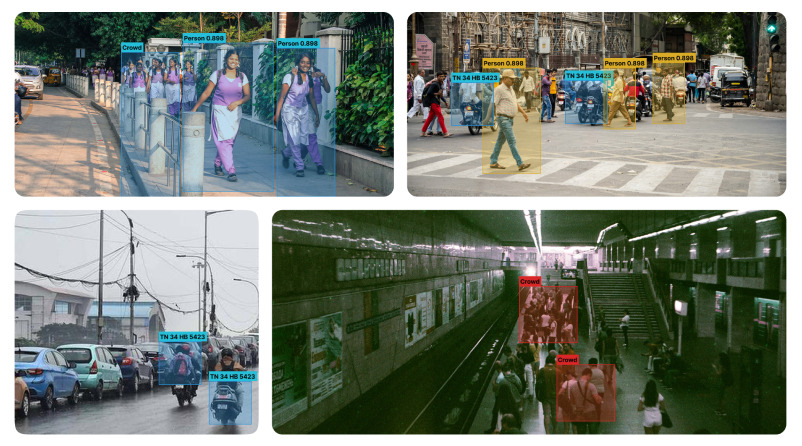
A visitor counting system installed in a retail store gathers data regarding where and how long customers can spend their time. Machine learning processes assist in this process by actionable insights that help retailers comprehend customer interactions. Nowadays, retail stores are harnessing people counting technology to gather data regarding their business operations.
Theft detection & managing safety
IP cameras equipped with computer vision can monitor the movement of employees, customer behaviour, store operations and actions in real time. Using depth sensors, the system ensures that decorum is maintained inside a store premises. It addresses policies, procedures and instructions for providing a high level of satisfaction. Harnessing computer vision algorithms, it analyzes peak hours and results in accurate footfall analytics.
Queue time analytics and productivity
Queue detection technology is gaining acceptance across retail industries. Customers always remain on the haul and higher wait times can ultimately lead to their dissatisfaction. Cameras integrated with queue detection can track and count the number of people in a line. Productivity analytics help in monitoring the operations of the workplace, and assist with collaboration and employee productivity.
Accident prevention & traffic signal detection
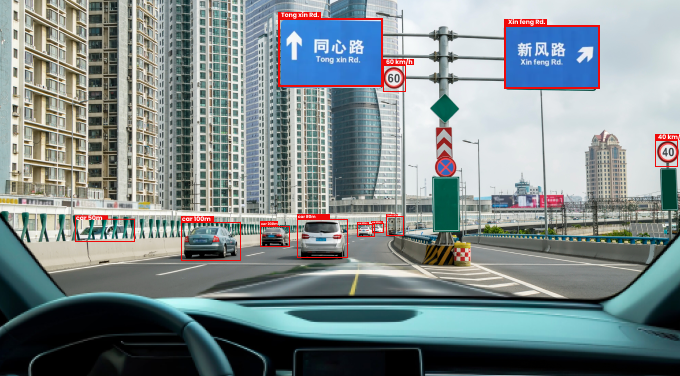
Vision AI applications are empowered with the potential to detect and recognize traffic signs in real time. In order to detect and classify traffic signals, vision strategies can segregate traffic signs at different times. With the integration of Automatic Number Plate Recognition (ANPR), vehicles can be detected and tracked in real-time helping traffic authorities in traffic management.
Facial detection in security & surveillance systems
Vision AI harnesses face detection algorithms for identifying individuals and tracking their movements by viewing the camera video feeds. It can also detect human faces against watchlists and databases. This is increasingly important across high-security environments like airports, public events and government facilities. Face detection helps in streamlining access control ensuring that only security personnel can gain entry to sensitive areas.
What are the emerging trends in face detection technology?
As a result of AI and machine learning advancements, face detection systems are becoming increasingly functional across various industries. Continuous authentication in addition to facial recognition is capable of advancing security providing seamless protection. In healthcare verticals, facial recognition helps improve patient identification by instantly verifying their identity. Additionally, face detection is capable of monitoring livestock health by assessing facial expressions to predict stress. Several industries such as retail and hospitality are capable of exploring face-based sentiment analysis to administer hyper-personalized customer interactions.
Businesses are increasingly adopting computer vision solutions for elevating their operations. As a reputed AI Computer Vision Development Company, Nextbrain is on the journey to fine-tune computer vision and direct businesses with the right facial detection technology. Many organizations have already found their ways to use this technology.
Challenges & considerations
Face detection comes with distinct challenges such as ethical concerns and technical limitations. One of the major glitches of unauthorized surveillance involves public gatherings and tracking people without their consent. If not abided by the margin of global standards, it is valuable to develop regulations that help protect privacy and assist with the ethical use of face detection. Real-time video processing comes with several hurdles such as high computational demands and maintaining accuracy under challenging conditions. In order to solve these barriers, edge computing and optimization are relevant for creating scalable applications.
Final thoughts
As the leading Computer Vision Development Company, Nextbrain helps businesses integrate face detection technology into existing systems and execute them smoothly. The company comprises a core team of dedicated professionals who specialize in computer vision, generative AI, GPU acceleration, edge computing, and natural language processing. We are equipped with the knowledge for creating AI innovations and managing extensive datasets and ensure seamless integration into your existing infrastructure.
We provide a wide array of solutions for delivering efficient results. Right from ensuring security, to improving operations and optimizing data processing, Nextbrain stays beside organizations and businesses helping them implement face detection technology seamlessly. Do you want to learn more about AI Computer Vision Development? Contact us today and streamline your business operations.


Saran
April 24, 2025 Author