The automotive industry is undergoing its most transformative era in history. Amidst the most groundbreaking developments is the advent of the self-driving vehicles that are capable of making decisions and navigating roads with minimal intervention. As AI continues to mature, it is redefining what mobility means and paving the way for a smarter and more effective transportation system. With the intelligent combination of computer vision and real-time decision-making, AI enables vehicles to respond and predict to several complicated road conditions without any human intervention.
Major companies such as Cruise, Tesla and Waymo have been able to push boundaries of autonomous driving technology. In this blogpost, we are going to explore more about how AI is serving as a revolutionary aspect in the automotive industry, creating smart transportation.
AI in Self-driving cars: Understanding its aspects
On merging advanced algorithms with onboard computing, AI is capable of transforming vehicles into systems that can navigate complex environments. Contrary to rule-based automation, AI systems are capable of learning through machine learning and neural networks. It enables cars to identify patterns and respond to unpredictable behaviour. AI-driven vehicles are capable of managing both routine and unexpected challenges effectively. Having AI at the core, cars are becoming more than just simple machines and more than just mobility partners.
The significance of AI in empowering autonomous driving
Advanced intelligence is empowered to interpret complex road environments in real time. AI in driverless cars can work through interconnected processes, each contributing to secure vehicle performance.

Data processing
Within the core of autonomous vehicles, AI systems are capable of tackling vast streams of information from cameras, GPS, radar and LiDAR. The effectiveness of the systems mainly depends on real-time integration, ensuring that the cars can interpret their surroundings. It enables cars to detect anomalies, map environments, and prepare for certain dynamic conditions.
Object detection & recognition
Powered by deep learning and computer vision, autonomous vehicles can continuously elevate their recognition accuracy. It brought us closer to safer roads and fewer accidents in the future.
Predictive decision-making
AI systems are capable of analyzing scenarios and directing vehicles to their next motion directive, may it be for changing lanes or giving brakes. Analyzing behavioral patterns such as vehicle trajectories, traffic flow and pedestrian movement, AI has the potential to predict what is supposed to happen afterwards. The decision-making models can reassure drivers and regulators that self-driving cars can function responsibly.
Machine learning for continuous improvement
With passing time and advancements in technologies, self-driving cars are improving over time. Leveraging machine learning algorithms, they learn and acknowledge from various data sources, effectively refining perception accuracy and decision making ability.
Learning & adaptation
Apart from the generally programmed responses, AI across self-driving cars can effectively learn from experience. Leveraging reinforcement learning and neural networks, systems easily adapt to new driving conditions and road patterns.
What are the AI innovations that reshape the automotive industry's car operations?

Smart Traffic & route optimisation
Artificial intelligence helps in selecting the fastest and safest routes by analysing real-time traffic, road conditions and weather. Not only does it reduce fuel consumption, travel time, but it also lowers overall emissions.
Autonomous ride-hailing fleets
Nowadays, companies are deploying AI-powered vehicles/taxis providing safe and contactless transportation. The fleets could significantly lower travel and reduce congestion in urban areas.
Intelligent manufacturing
AI is constantly transforming the way cars operate, empowering manufacturing facilities and factories effectively. Predictive maintenance paired with a quality inspection system enhances vehicle reliability and boosts production timelines.
Autonomous driving algorithms
Machine learning models assist self-driving cars detect objects and predict their movement in addition to supporting real-time driving decisions. Computer vision leverages algorithms such as CNNs for interpreting sensor data, detecting objects and comprehending the environment.
Reduced traffic congestion & environmental impact
Driving with precision, AI autonomous vehicles maintain optimal speed and reduce sudden stops that often cause congestion. With the selection of effective routes and preventing traffic bottlenecks, it effectively lowers fuel consumption and different kinds of emissions. With the integration of AI Development Services in electric cars, AI-powered self-driving vehicles play a major role in lowering the transportation sector’s environmental footprint.
Smart traffic management
Analyzing real-time conditions as well as predictive flow patterns, advanced intelligence allows smarter traffic flow patterns. Cars powered with AI self-driving mechanisms share valuable data with traffic systems for optimizing signal timings, lowering wait times and streamlining vehicle coordination. Establishing round the clock communication assists in preventing unnecessary stops and smooth movement.
Increased mobility
As a renowned AI development company, Nextbrain’s primary focus With the rapid adoption of AI technology, self-driving cars can close accessibility gaps and also make mobility easier. It assists in creating newer opportunities for people who generally face challenges comprising the visually impaired.
What are the core AI Technologies empowering self-driving cars?
The strength of core AI technologies lies in advanced-edge AI technologies. In this context, we are going to emphasise the different technologies.
Machine learning models
Machine learning enables self-driving cars to educate themselves over the course of time. The models can process large datasets from real-world driving skills to foretell scenarios. Additionally, it can adapt to distinct road conditions and fine-tune responses. Using polished learning, self-driving vehicles continue to improve safety standards and effectiveness.
Computer vision
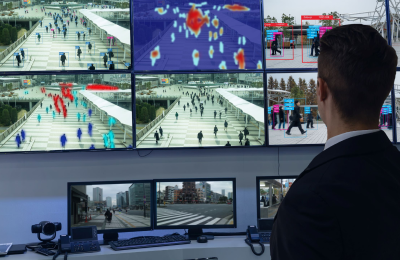
Combining AI-powered vision systems in the automotive industry has major benefits. From enabling 360 degree monitoring to real-time obstruction detection and driver monitoring, vision AI systems have potential that amplifies overall safety compliances within an urban city infrastructure. When it is combined with deep learning algorithms, computer vision ensures exact object recognition, decision making and many more.
Edge AI & real-time processing
Edge AI supports the automotive industry with an autonomous vehicle process that reduces overall latency, enabling vehicles to make split-second decisions when faced with sudden hazards. The technology enforces real-time processing important for the safety of the automotive industry. It ensures rapid response while keeping connectivity demands intact.
The future of smart cars: With vision AI
With vision AI, the next generation of smart cars will be more defined and run by computer vision systems. It enables systems to visualise, comprehend and react to the world with intellectual intelligence. Beyond perception, computer vision systems powered by AI elevate predictive driving by anticipating the actions of other vehicles and users to prevent collisions and enhance safety compliance.
With cars constantly learning from real-world data, computer vision systems can drive this shift towards completely autonomous mobility options. In the long run, vision AI systems can transform smart cars into intelligent companions, delivering safer and smoother transportation.
Conclusion
After a wholesome observation of smart cars and how AI is changing the scenario, it can be concluded that AI is the primary driving force behind the shift from traditional vehicles to intelligent systems. From remodelling transportation by elevating safety standards to increased efficiency and environmental sustainability, AI has become the part and parcel of smart self-driving cars.
Are you ready to enter the world of smart cars or self-driving vehicles? Looking to embrace AI for your automotive business?
Get in touch with us to know more about AI development solutions and how they are impacting the automotive industry.
Frequently asked questions
How can AI be used in self-driving cars?
AI assists self-driving cars to visualise the road, predict what other drivers and passers-by will do, and take real-time, valuable decisions. It enables vehicles to identify objects, monitor blind spots, and detect traffic signs for preventing any kind of collisions. By processing sensor data, it can control steering, braking, and acceleration to keep the urban city roads safe.
Do you guarantee that your AI technology will predict the actions?
Yes, as the reputed AI App Development Company, our innovative vision AI system uses machine learning to analyze patterns and predict the movement of other road users. The predictive potential assists autonomous vehicles in making safer decisions on the road.
How does a vision AI system help in lowering traffic congestion?
Adapting to real-time traffic conditions, AI is capable of optimizing routes, helping in advanced traffic flow. With time, smart vehicles are estimated to lower congestion significantly.
On what mechanism does the AI learning technique work in driverless cars?
Driverless cars often rely on deep learning as a type of machine learning that trains algorithms leveraging immense amounts of driving data. The systems are capable of learning to recognize patterns such as pedestrians, lane markings, stopping signs and adapting their responses in real-world scenarios through ongoing training.
Is AI used inside the car cabin as well?
Yes, AI empowers voice assistants and driver monitoring systems for distracting, improving comfort and safety.
What does the future of AI-powered transportation look like?
With rapid technological advancements going around, the future of AI-powered transportation looks vibrant and bright. It delves deeper into connected smart cities, predictive traffic systems and sustainability. It has the potential to transform transportation into a smarter and safer ecosystem.


Saran
April 01, 2026 Author